
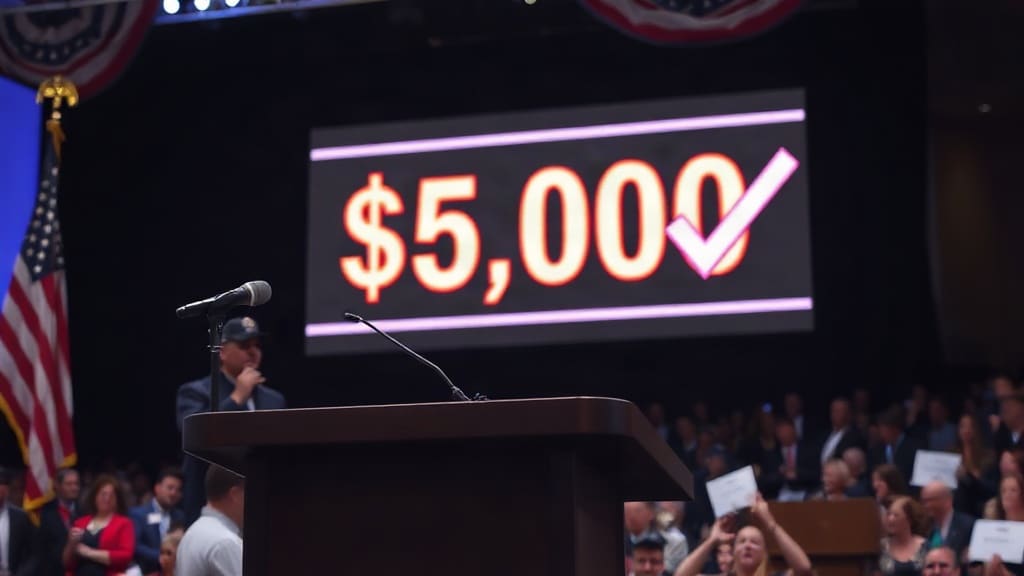
The political landscape just got a jolt. At a recent party convention, former President Donald Trump floated an idea that sounds more like a stimulus check than a standard campaign promise: every adult American would receive $5,000 if Republicans win the upcoming midterm elections. The announcement, delivered with characteristic confidence, was light on specifics but heavy on headline potential. It immediately sparked a firestorm of reaction from economists, political opponents, and voters trying to figure out whether this is a serious policy proposal or simply a rhetorical flourish designed to energize the base.
The Promise in Context
Trump's statement came during a speech aimed at rallying Republican supporters ahead of a critical election cycle. He framed the $5,000 payment as a direct benefit to ordinary Americans, contrasting it with what he described as wasteful spending by the current administration. The former president did not explain how the program would be funded, whether it would be a one-time payment or recurring, or what eligibility criteria would apply beyond being an adult citizen. This lack of detail is not unusual for Trump's campaign-style announcements, which often prioritize emotional appeal over fiscal mechanics.
Political analysts quickly noted that such a proposal would carry an astronomical price tag. With roughly 258 million adults in the United States, a $5,000 payment to each would cost approximately $1.29 trillion. That figure rivals the entire federal discretionary budget for a year and would require either massive deficit spending, significant tax increases, or deep cuts to existing programs. None of those options were addressed in the speech, leaving observers to speculate about the seriousness of the plan.
Feasibility and Fiscal Reality
Economists from across the ideological spectrum were quick to weigh in. Even those sympathetic to direct cash transfers questioned the practicality of such a large, untargeted payout. The closest historical parallel is the series of stimulus checks issued during the COVID-19 pandemic, which totaled about $850 billion across three rounds. Trump's proposal would be roughly 50% larger than all pandemic stimulus payments combined, and unlike those emergency measures, it would not be tied to an economic crisis.
Funding mechanisms are the elephant in the room. The federal government already runs a structural deficit exceeding $1 trillion annually. Adding another $1.3 trillion in spending would likely require borrowing, which could push interest rates higher and crowd out private investment. Alternatively, the government could print money, but that risks igniting inflation, a problem that has already proven politically damaging for the current administration. Some supporters argue that the payment would pay for itself through increased consumer spending and economic growth, but that theory, known as supply-side economics on steroids, has little empirical support for a one-time cash infusion of this magnitude.
Political Strategy and Messaging
From a purely political standpoint, the promise is a masterstroke of attention-grabbing. In an era of short news cycles and social media virality, a $5,000 check is a concrete, easily understood number that appeals directly to voters' wallets. It also taps into a broader populist narrative that Republicans are the party of the working class, despite the party's traditional association with fiscal conservatism. Trump's ability to bend the party to his personal brand has been on display repeatedly, and this proposal may force other Republican candidates to either embrace it or awkwardly distance themselves.
Democrats, meanwhile, have seized on the announcement as evidence of Republican fiscal irresponsibility. They point to the lack of a funding source and the potential for inflation as reasons the plan is unserious. Some have also noted the irony of a party that has criticized student loan forgiveness and expanded child tax credits as too expensive now proposing a far larger universal payment. The back-and-forth is likely to dominate cable news segments and campaign ads in the coming weeks.
Voter Reaction and Economic Anxiety
For many voters, the promise of $5,000 is undeniably attractive, especially in a time of high inflation and economic uncertainty. Grocery bills, rent, and gas prices have squeezed household budgets, and a cash infusion would provide tangible relief. However, there is also a healthy dose of skepticism. Americans have heard big promises before, from healthcare reform to infrastructure weeks, and have learned that campaign rhetoric does not always translate into policy. The question on many minds is whether this is a genuine commitment or just another example of political theater.
Polling data on the proposal is not yet available, but anecdotal evidence suggests a split along partisan lines. Republican voters are more likely to view the plan favorably, seeing it as a bold move to put money back in the hands of citizens. Democrats and independents are more skeptical, questioning where the money would come from and whether it would actually materialize. The lack of specifics from Trump's camp only fuels the uncertainty.
Historical Precedents and Comparisons
The idea of universal cash payments is not new. Proposals for a universal basic income have been floated by figures ranging from Thomas Paine to Andrew Yang. However, those plans typically involve recurring payments funded by tax restructuring or resource dividends, not one-time political payouts. The closest analogy to Trump's proposal might be the $1,200 checks sent to most Americans in 2020 under the CARES Act, which Trump himself signed into law. Those payments were popular, but they were also tied to a specific emergency and were far smaller in scale.
Another point of comparison is the Alaska Permanent Fund, which pays residents an annual dividend from oil revenues. That program, while successful, distributes only about $1,000 to $2,000 per person per year, and it is funded by a dedicated revenue stream, not general taxation. Trump's proposal lacks any similar funding mechanism, making it more akin to a campaign giveaway than a sustainable policy.
Legal and Logistical Hurdles
Even if Republicans were to win both houses of Congress, implementing a $5,000 payment would face significant legal and logistical challenges. The proposal would need to be drafted into legislation, passed by both chambers, and signed by the president. Given the current partisan divide, it is unlikely to attract any Democratic support, meaning Republicans would need to use the budget reconciliation process, which requires only a simple majority. However, reconciliation rules limit what can be included in such bills, and a massive new spending program might not qualify without creative accounting.
Logistically, the government would need to determine who counts as an "adult American" for the purposes of the payment. Would it include non-citizens with legal residency? What about incarcerated individuals? The IRS, which handled previous stimulus payments, would face a monumental task in distributing checks to over 250 million people, especially if the program is rushed. Fraud prevention would also be a major concern, as seen with pandemic-era programs that lost billions to improper payments.
The Broader Economic Debate
Beyond the immediate political squabble, Trump's proposal raises deeper questions about the role of government in providing direct cash transfers. Proponents argue that such payments are the most efficient form of welfare because they allow individuals to spend money according to their own needs, without bureaucratic overhead. Critics counter that universal payments are wasteful because they go to people who do not need them, and that the money would be better spent on targeted programs like food assistance or job training.
The inflationary impact is another key concern. If the government injects $1.3 trillion into the economy overnight, the increased demand for goods and services could push prices higher, especially if supply chains remain constrained. The Federal Reserve, which has been raising interest rates to combat inflation, would likely view such a fiscal expansion as counterproductive to its efforts. This tension between fiscal and monetary policy could create a volatile economic environment.
What Comes Next?
As the midterm elections approach, Trump's $5,000 promise is likely to remain a talking point on both sides of the aisle. Republican candidates will be asked whether they support the plan, and their answers could reveal divisions within the party. Some may embrace it as a bold populist measure, while others may distance themselves, citing fiscal responsibility. For Trump, the proposal serves as another reminder of his continued influence over the Republican Party and his ability to set the terms of debate.
For voters, the promise is a test of credibility. Will they believe that such a payment is actually possible, or will they dismiss it as empty rhetoric? The answer may depend on their trust in Trump and their assessment of the Republican Party's ability to deliver. In an election cycle defined by economic anxiety, a $5,000 check could be a powerful motivator, but only if voters see it as realistic.
Frequently Asked Questions
Is the $5,000 payment a done deal if Republicans win?
No. The proposal is currently just a statement by former President Trump. Even if Republicans win both the House and Senate, the plan would need to be introduced as legislation, pass through Congress, and be signed by the president. There is no guarantee that it would become law, and many details, including funding, remain unspecified.
Where would the money for the $5,000 payments come from?
Trump did not provide a funding source. The most likely options would be increased federal borrowing, tax increases, or spending cuts elsewhere. Each of these has significant economic and political challenges. Without a clear plan, the feasibility of the payment is questionable.
Would every adult really get $5,000, including wealthy people?
Based on Trump's statement, the payment would go to "every adult American," which suggests no income limits. However, this could change if the proposal is developed into actual policy. Universal payments are often criticized for going to those who do not need them, but they are also simpler to administer.
How does this compare to the COVID stimulus checks?
The COVID stimulus checks were smaller ($1,200, $600, and $1,400 per adult) and were tied to an economic emergency. Trump's proposal is significantly larger and not linked to a specific crisis. The total cost of all pandemic stimulus payments was about $850 billion, while this plan would cost over $1.3 trillion.
Could this cause inflation?
Potentially, yes. Injecting $1.3 trillion into the economy would increase consumer spending, which could drive up prices if supply does not keep pace. The Federal Reserve is currently trying to reduce inflation, and such a large fiscal stimulus could work against those efforts.