
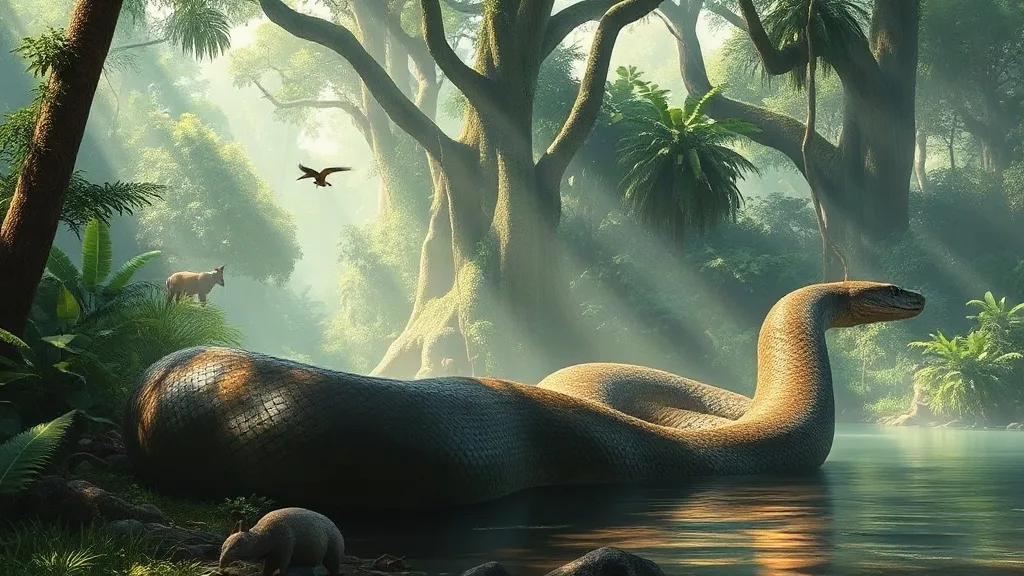
In a discovery that has paleontologists buzzing, researchers have unearthed the fossilized remains of a colossal snake in India that slithered through ancient rainforests some 47 million years ago. Dubbed Vasuki indicus, this prehistoric giant may have stretched up to 50 feet (15 meters) in length, placing it among the largest snakes ever to have existed. The find, described in a recent study, offers a rare window into the size and behavior of ancient reptiles and raises intriguing questions about the ecosystems they dominated.
A Serpent of Mythic Proportions
The name Vasuki indicus is a nod to Vasuki, the mythical serpent king often depicted coiled around the neck of the Hindu god Shiva. It's a fitting moniker for a creature that could have looked like something out of legend. The fossil, recovered from a lignite mine in Gujarat, India, consists of around 27 vertebrae, some of which are remarkably well-preserved. Based on the size of these bones, scientists estimate the snake's body length at anywhere between 36 and 50 feet, with the upper end rivaling the iconic Titanoboa, a 40-foot snake that lived in South America about 60 million years ago.
What makes Vasuki indicus particularly striking is its bulk. The vertebrae are wide and thick, suggesting a snake that was not only long but also incredibly heavy. Researchers believe it could have weighed over a ton, making it a formidable presence in its environment. "This was a snake that would have been a top predator," says one of the study's authors. "Its size alone would have made it a threat to almost anything it encountered."
Life in a Warmer World
During the Eocene epoch, when Vasuki indicus lived, India was a lush, tropical landscape, home to early whales, primitive primates, and a host of other creatures. The climate was significantly warmer than today, with no polar ice caps and global temperatures several degrees higher. Such conditions favored the evolution of large-bodied reptiles, which rely on external heat to regulate their metabolism. The warmer it is, the bigger a snake can grow.
This principle, known as Bergmann's rule, is often applied to endotherms (warm-blooded animals), but it also holds for many ectotherms. In a hot, humid environment, a snake can afford to be massive because it can warm up quickly and efficiently. Vasuki indicus likely thrived in this greenhouse world, its enormous size an advantage in capturing prey and avoiding becoming a meal itself.
An Ambush Predator, Not a Speedster
If you imagine a 50-foot snake, you might picture it chasing down prey with terrifying speed. But the fossil evidence tells a different story. The vertebrae of Vasuki indicus are robust but not built for rapid, agile movement. Instead, they suggest a slow-moving ambush predator, much like today's anacondas and pythons. These snakes coil in wait, using their powerful bodies to strike at passing prey and constrict it into submission.
An ambush strategy makes sense for a snake of such proportions. Moving a body that large requires a lot of energy, so it's more efficient to lie in wait and let dinner come to you. In the dense forests of ancient India, Vasuki indicus would have been a silent, nearly invisible threat until it was too late.
Filling a Gap in the Fossil Record
Snake fossils are notoriously rare. Their skeletons are lightweight and loosely connected, so they tend to fall apart and decay before they can be buried and fossilized. That's why the discovery of any ancient snake, let alone one this large, is cause for excitement. The Vasuki indicus fossils were found in a lignite mine, a type of soft brown coal that preserves organic material in exceptional detail. The vertebrae were scattered but identifiable, allowing researchers to reconstruct the snake's size and anatomy.
The find also helps fill a geographic gap. Most giant prehistoric snakes have been found in South America, such as Titanoboa in Colombia. Vasuki indicus shows that gigantism in snakes wasn't limited to one region; it evolved independently in India as well. This suggests that given the right conditions, snakes can grow to enormous sizes in different parts of the world.
What Did It Eat?
With a body that long and heavy, Vasuki indicus could have preyed on a variety of animals. Fossil evidence from the same region indicates the presence of large turtles, crocodilians, and early mammals. A snake of this size could have tackled prey as large as a modern deer or even a small rhinoceros. Its jaws, though not preserved, would have been capable of opening wide to swallow large meals, just like modern anacondas.
It's also possible that Vasuki indicus was a specialist, targeting a particular type of prey that was abundant in its environment. Without more fossils, including skull material, it's hard to say for sure. But the potential for such a powerful predator underscores the complexity of Eocene ecosystems.
Why This Discovery Matters
Beyond the sheer awe factor, the discovery of Vasuki indicus has real scientific value. It provides a new data point for understanding how body size evolves in snakes and how ancient climates influence the maximum size a species can reach. It also highlights the importance of museum collections and field work in unearthing the past. The fossil was found in a mining area, reminding us that valuable scientific treasures can turn up in unexpected places.
Moreover, the study of giant snakes like Vasuki indicus and Titanoboa can inform modern conservation. As climate change warms the planet, some scientists wonder if snakes might evolve larger sizes again. While that's a long-term prospect, understanding the relationship between temperature and body size in reptiles can help predict how today's species might respond to a warming world.
Ongoing Research and Future Questions
The research team is continuing to analyze the fossils and search for more remains. Key questions remain: What did Vasuki indicus look like? How did it move? What was its bite force? Finding a skull would be a game-changer, as it would reveal details about its diet and sensory abilities. For now, the vertebrae alone tell a compelling story of a giant that once ruled the Indian subcontinent.
As paleontologists dig deeper into India's rich fossil beds, more discoveries are likely. Each new find adds a piece to the puzzle of prehistoric life, showing us that the past was stranger and more wondrous than we often imagine.
Frequently Asked Questions
How big was Vasuki indicus compared to Titanoboa?
Vasuki indicus is estimated to have reached up to 50 feet (15 meters) in length, while Titanoboa could grow to about 40 feet (12 meters). So Vasuki may have been slightly longer, but both were in the same league of giant snakes. Weight estimates are less certain, but both were likely over a ton.
When did Vasuki indicus live?
It lived during the Eocene epoch, about 47 million years ago. At that time, India was a tropical island continent, and the climate was much warmer than today.
What did Vasuki indicus eat?
Based on its size and the available prey in its environment, it likely fed on large turtles, crocodilians, and early mammals. Like modern anacondas, it was probably an ambush predator that constricted its prey.
Why are snake fossils so rare?
Snake skeletons are fragile and disarticulate easily after death, so they rarely fossilize. That's why each discovery of a prehistoric snake is scientifically valuable.
Could there be even larger prehistoric snakes?
It's possible. The fossil record is incomplete, and there may be undiscovered species that were even larger. However, there are physical limits to how big a snake can get, based on temperature, prey availability, and biomechanics.