
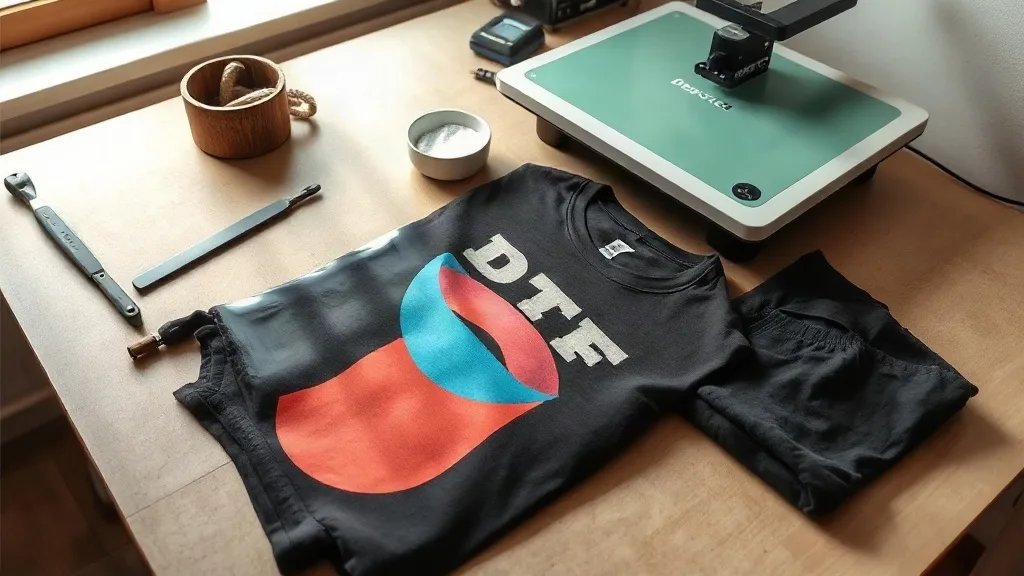
Most people who try dtf transfers for the first time do it for one reason: they want full-color prints on a shirt without buying a $15,000 printer. That is the honest appeal of the format. A design gets printed onto a film, dusted with adhesive powder, cured, and then heat pressed onto fabric. No weeding, no color separation, no minimum order of 144 pieces.
But the gap between a transfer that survives fifty washes and one that peels in a week is not luck. It comes down to ink load, powder coverage, film quality, and how carefully you press. This guide walks through what actually matters, drawn from the kind of trial-and-error that happens in a small shop where every wasted shirt costs real money.
What a DTF transfer actually is
Direct-to-film printing works by printing a mirrored design onto a special PET film using pigment inks, usually white ink as a base layer and then CMYK on top. While the ink is still wet, a hot-melt adhesive powder is applied. The excess powder is shaken off, and the film goes through a curing step so the powder melts into the ink. What you end up with is a flexible, plastisol-free transfer that can be pressed onto cotton, polyester, blends, canvas, and even some nylon.
That versatility is the reason dtf took over so much of the small-batch apparel market. Screen printing still wins on cost per unit at volume, and vinyl cutting still wins for simple one-color text. But for a twelve-shirt order with a photographic design, nothing else comes close on setup effort.
How it differs from DTG and vinyl
Direct-to-garment printing sprays ink straight onto the shirt, which means the shirt has to be pre-treated and loaded flat on a platen. DTF skips the pre-treatment and lets you print a batch of transfers ahead of time, store them, and press them whenever an order comes in. Vinyl, by contrast, requires cutting and weeding and struggles with gradients or fine detail.
The practical trade-off with DTF is feel. A well-pressed transfer has a slightly raised, rubbery hand, especially over large solid areas. On lightweight tri-blends this is noticeable. On hoodies and heavy cotton tees, most customers do not register it at all.
Judging transfer quality before you commit
Not all films are made to the same standard, and the difference is visible if you know where to look. Here is what to check when you receive a batch.
- Powder coverage: Hold the film up to a light. The adhesive should look even and slightly frosty across the entire printed area. Patchy or glossy spots mean the powder did not adhere properly, and those areas will fail first.
- Edge definition: Fine lines and small text should stay crisp. Fuzzy edges usually signal too much ink or a curing problem.
- Film stiffness: A good cured transfer has a slight curl but should not crack when you flex it gently. Cracking before pressing is a bad sign.
- White opacity: Press a sample onto a dark shirt. If the white looks grey or lets the garment color through, the white ink layer is too thin.
If you are sourcing locally, it is worth searching for dtf transfers near me and requesting a sample pack before placing a bulk order. A single test press tells you more than any spec sheet.
Pressing settings that actually hold up
The most common failure mode is under-pressing, not over-pressing. People set the press to 300°F, give it eight seconds, and wonder why the corners lift after a few washes. The adhesive needs enough time and pressure to flow into the fabric fibers.
A reliable starting point
- Pre-press the garment for 5 to 7 seconds to remove moisture. This step is skipped constantly and it matters, especially with cotton.
- Set the press to 300 to 320°F with medium to firm pressure.
- Peel the film while it is still warm, usually within a few seconds. Most modern films are designed for warm peel.
- Cover the design with parchment or a Teflon sheet and press again for 5 to 8 seconds. This second press sets the adhesive into the weave and dramatically improves wash durability.
Cold peel films exist too, and they behave differently. Always confirm which type you have before you start a run, because peeling a warm-peel film cold will pull half the design off with the carrier.
Fabric matters more than most people expect
DTF adheres best to smooth, tightly woven surfaces. Rough open-knit fabrics, heavily textured fleece, and garments with a silicone or water-repellent finish are where problems show up. If a shirt has a softener coating, pre-washing it once can improve adhesion noticeably.
Stretch is the other factor. On high-spandex activewear, a large solid print will eventually crack along stress lines. Smaller designs, or designs with a lot of negative space, handle stretch far better. This is not a defect in the transfer; it is physics.
Storage and shelf life
Cured transfers keep well if you treat them right. Store them flat or loosely rolled, away from heat and direct sunlight, in a dry space. Stacking heavy items on top of a pile of films can crush the powder layer and cause press defects. In a normal indoor environment, most films stay usable for six to twelve months, though older stock may need a slightly longer press time.
When DTF is the wrong choice
Being honest about limits saves money. If you need a print that feels like bare fabric on performance wear, DTG or sublimation will serve you better. If you are producing a thousand identical one-color shirts, screen printing will undercut DTF on price. And if a customer wants a print on a coated nylon jacket, test first, because adhesion on coated synthetics is inconsistent at best.
For everything in between, which is most real-world orders, DTF is a sensible default. It rewards careful pressing and punishes shortcuts, which is a fair trade.
Frequently asked questions
How many washes should a DTF transfer survive?
With correct pressure, temperature, and a proper second press, a quality transfer typically holds up through fifty or more home launderings. Washing inside out in cold water and avoiding high dryer heat will extend that considerably.
Can I press DTF transfers with a home iron?
You can, but results are inconsistent. A home iron does not deliver even pressure across a large area, so edges and corners tend to lift. For anything you care about, a clamshell or swing-away heat press is worth the investment.
Do DTF transfers work on dark and light shirts equally?
Yes, because the white ink base layer sits under the color. That is one of the format's main advantages over DTG, where dark garments require pre-treatment and often show a slight halo around the print.
Why is my transfer peeling at the corners?
Corner lift almost always traces back to three causes: insufficient pressure at the edges of the platen, moisture still in the garment, or peeling the film at the wrong temperature. Check all three before blaming the film.
Is DTF safe for children's clothing?
Most reputable suppliers use pigment inks and adhesives formulated to meet standard textile safety requirements. Ask your supplier for documentation on the specific film you are buying, since formulations vary between manufacturers.