
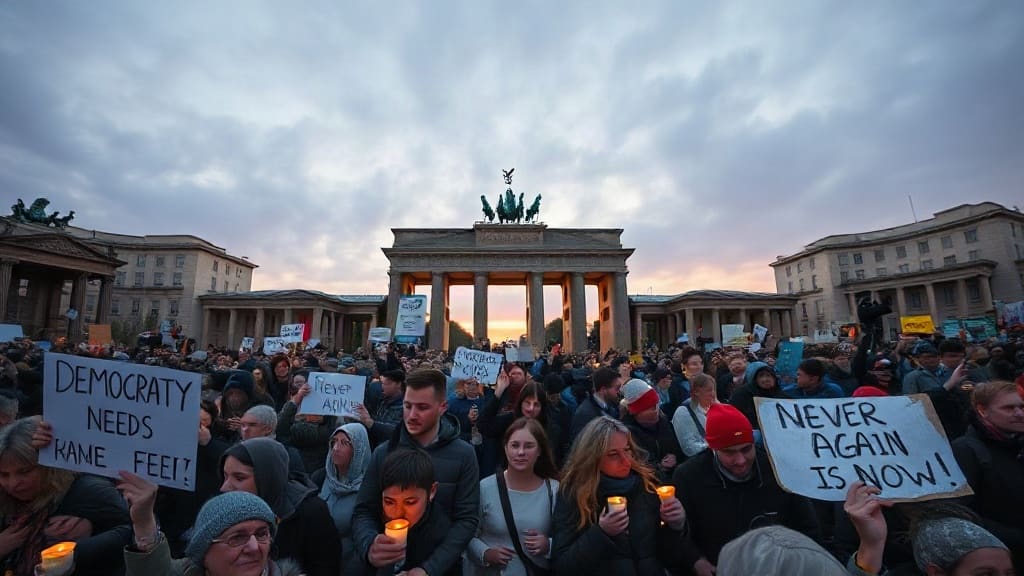
The air in Berlin felt different on Monday evening. Thousands of people, many carrying handmade signs and candles, gathered at the Brandenburg Gate not to celebrate but to sound an alarm. Their message was simple: the far-right Alternative für Deutschland, fresh off a historic victory in the state of Saxony-Anhalt, must not be allowed to repeat that success in two more regional elections this month. What began as a local shockwave has now become a national reckoning.
The protests, largely peaceful and organized through a mix of civil society groups, trade unions, and grassroots networks, reflect a deep anxiety that Germany's political center is failing to hold. The AfD's win in Saxony-Anhalt was not just a symbolic setback; it gave the party its first state-level executive power in postwar history. Now, with Berlin and Mecklenburg-Western Pomerania set to vote within weeks, the stakes have never been higher for those who oppose the AfD's brand of anti-immigrant, pro-Russian nationalism.
Why Saxony-Anhalt Changed Everything
For years, Germany's established parties treated the AfD as a protest movement that would eventually fade. That assumption collapsed on election night in Saxony-Anhalt, where the AfD secured a plurality of seats and the ability to form a coalition. The party's campaign leaned heavily on fears about migration, economic stagnation, and a perceived loss of national identity. But critics say its policies go far beyond rhetoric.
The AfD has openly called for mass deportations of asylum seekers, a rollback of state support for renewable energy, and the defunding of public broadcasting. Its leaders have also expressed admiration for Russia's government, a stance that has drawn sharp criticism given the ongoing war in Ukraine. In Saxony-Anhalt, the party's success was fueled by a combination of rural discontent and a sense that mainstream parties had ignored ordinary voters' concerns.
But the victory did not go unanswered. Within hours, protests erupted in cities across the country, from Hamburg to Munich. In Berlin, the demonstration at the Brandenburg Gate was described by organizers as a "pro-democracy rally" rather than a partisan event. Speakers included local politicians, activists, and even a few celebrities, all urging voters to reject extremism at the ballot box. The mood was somber but determined.
The Next Battlegrounds: Berlin and Mecklenburg-Western Pomerania
If Saxony-Anhalt was the warning shot, Berlin and Mecklenburg-Western Pomerania are the main event. Both states hold elections this month, and polls suggest the AfD is within striking distance of first place in both. That prospect has sent shockwaves through Germany's political establishment and energized the protest movement.
Berlin, long considered a bastion of progressive politics, now faces a reality where the AfD could win the most seats in its city parliament. The capital's diverse population and vibrant civil society make it an unlikely AfD stronghold, but dissatisfaction with housing costs, public transportation, and crime has created an opening. The AfD has seized on these issues, blending them with anti-immigrant rhetoric and a call for a "return to order."
Mecklenburg-Western Pomerania, a rural state on the Baltic coast, presents a different challenge. The region has struggled with depopulation, aging infrastructure, and a sense of being left behind by Germany's economic engine. The AfD's message of economic nationalism and cultural preservation resonates strongly there, and the party has invested heavily in local organizing. A win in Mecklenburg-Western Pomerania would give the AfD control of a state with direct access to the sea, a symbolic and strategic prize.
Protest organizers are aware of these dynamics. In Berlin, they have framed the demonstrations as a defense of the city's open, multicultural identity. In Mecklenburg-Western Pomerania, smaller but no less passionate rallies have taken place in towns like Schwerin and Rostock, often organized by church groups and local volunteers. The common thread is a rejection of what the AfD represents, not just a preference for other parties.
What the Protests Mean for German Democracy
The wave of anti-AfD protests is not just about one election or one party. It is a test of whether Germany's democratic institutions can withstand a sustained challenge from the far right. The country's postwar political culture was built on a commitment to never again allow extremism to gain power. That commitment is now being tested in real time.
One of the most striking features of the protests is their breadth. They are not limited to young people or urban elites. In many cities, demonstrators include retirees, working-class families, and first-time activists. Labor unions, which have historically been cautious about political protests, have joined in. Even some business leaders have spoken out, warning that the AfD's anti-EU stance could harm Germany's export-driven economy.
But the protests also reveal a deeper frustration. Many Germans feel that mainstream parties have failed to address the root causes of the AfD's rise: inequality, immigration, and a loss of trust in institutions. The protests may be a necessary response, but they are not a solution. Unless the center-left and center-right parties offer a compelling alternative, the far right will continue to gain ground.
The Road Ahead: A Nation at a Crossroads
As the protests continue, Germany faces a series of critical questions. Will the demonstrations translate into higher turnout among anti-AfD voters? Will the mainstream parties form coalitions to keep the AfD out of power, even if it means uncomfortable compromises? And what happens if the AfD wins again, despite the protests?
History offers few easy answers. In other European countries, far-right parties have sometimes been contained through broad coalitions, but that strategy has also led to political gridlock and voter disillusionment. In Germany, the stakes are particularly high because of the country's history and its role as Europe's largest economy. A far-right government in Berlin or Mecklenburg-Western Pomerania would send shockwaves far beyond Germany's borders.
For now, the protesters at the Brandenburg Gate and elsewhere are focused on the immediate task: persuading their fellow citizens to vote. Their signs carry messages like "Never again is now" and "Democracy needs you." Whether those messages will be enough to stop the AfD's momentum remains to be seen. But one thing is clear: Germany is no longer a country where the far right can be dismissed as a fringe movement. It is a central player in the nation's political drama, and the outcome of this month's elections will shape the country for years to come.
Frequently Asked Questions
Why are people in Germany protesting against the AfD?
People are protesting because the AfD, a far-right party, won the state election in Saxony-Anhalt and is poised to do well in upcoming elections in Berlin and Mecklenburg-Western Pomerania. Protesters oppose the party's anti-immigrant policies, its calls for mass deportations, its pro-Russian stance, and its attacks on renewable energy and public broadcasting. They see the AfD as a threat to German democracy and social cohesion.
What does the AfD stand for?
The AfD, or Alternative für Deutschland, is a far-right political party in Germany. It advocates for strict limits on immigration, including mass deportations of asylum seekers, and opposes Germany's support for Ukraine. The party also wants to roll back state support for renewable energy and defund public broadcasting. Critics say its positions undermine democratic norms and echo extremist rhetoric from Germany's past.
Which two German states are holding elections soon?
The two states are Berlin, the capital city-state, and Mecklenburg-Western Pomerania, a rural state on the Baltic coast. Both are holding regional elections this month, and polls suggest the AfD could win the most seats in both. A victory in either state would be a major breakthrough for the far right and would likely trigger further protests and political instability.
How have mainstream German parties responded to the AfD's rise?
Mainstream parties have struggled to respond effectively. Most have ruled out forming coalitions with the AfD, a strategy known as a "firewall." However, this has sometimes led to awkward alliances among parties that disagree on many issues. Some politicians have tried to co-opt the AfD's talking points on immigration, while others argue for a more robust defense of democratic values. The protests have added pressure on these parties to take a clearer stand.
Is the AfD likely to win in Berlin or Mecklenburg-Western Pomerania?
Polls show the AfD is competitive in both states, but the outcome is uncertain. Berlin's diverse population and strong civil society may limit the AfD's appeal, though dissatisfaction with housing and crime could help the party. In Mecklenburg-Western Pomerania, the AfD has a stronger base due to rural discontent and economic anxiety. A lot will depend on voter turnout and whether the protests motivate anti-AfD voters to show up at the polls.