A Shocking Shift in Theoretical Astrophysics
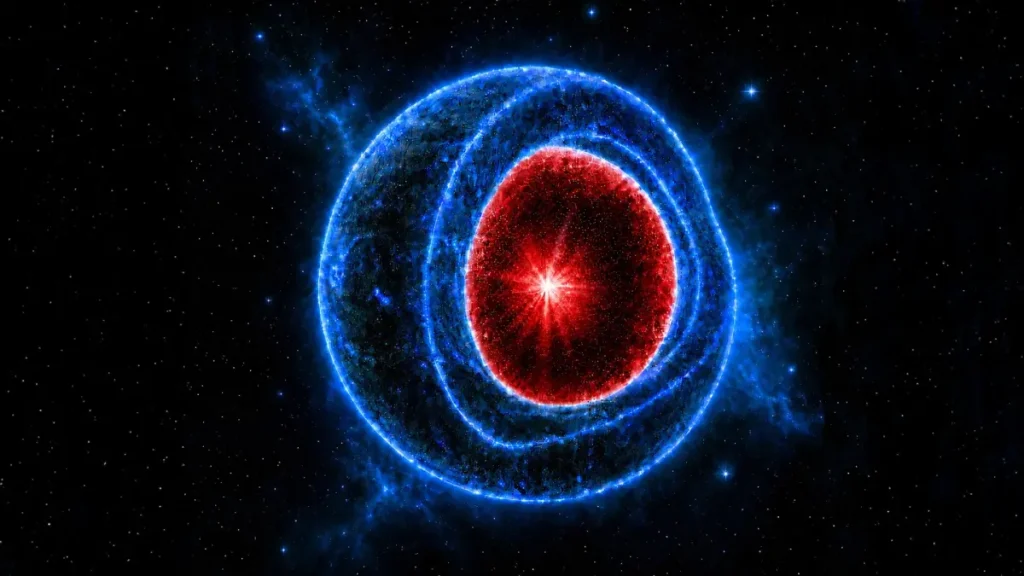
The global scientific community is currently evaluating a highly disruptive cosmological theory that completely challenges our understanding of stellar death. For decades, traditional astrophysics has operated on the absolute assumption that when a massive star exhausts its nuclear fuel, it collapses inward to form an infinitely dense black hole. However, groundbreaking theoretical mathematics suggests this mechanism might actually serve as the cosmic birthplace for an entirely new universe.
This radical paradigm shift attempts to resolve one of the most frustrating mathematical anomalies in modern physics: the singularity. By applying advanced gravitational models that account for the quantum properties of matter, physicists are painting a completely different picture of the cosmos. Instead of crushing matter into a terrifying point of infinite density, the collapse of a dying star may trigger a massive, localized expansion, creating a hidden reality on the other side of the event horizon.
The Einstein-Cartan Gravity Framework
To successfully bypass the mathematical breakdown associated with traditional black holes, researchers rely heavily on an extended branch of physics known as the Einstein-Cartan theory. Standard general relativity perfectly describes the macroscopic curving of spacetime, but it notoriously fails to account for the intrinsic quantum spin of subatomic particles. Integrating these vital quantum mechanics into the gravitational equation fundamentally changes how matter behaves at extreme densities, allowing for a new universe to emerge.
Under this highly complex theoretical framework, the particles composing the dying star do not simply compress into nothingness. Instead, as the density reaches incomprehensible levels at the core of the collapse, the intrinsic spin of the fermions generates a powerful, counteracting repulsive force. This crucial mathematical adjustment prevents the physical formation of a singularity, providing a completely rational, mathematically sound alternative to the infinite crush.
Torsion as a Repulsive Cosmic Force
The defining physical mechanism driving this incredible phenomenon is referred to by quantum physicists as spacetime torsion. At everyday densities, this torsion is entirely negligible, completely overpowered by standard gravitational attraction. However, as the massive star violently collapses inward, the concentration of particle spin creates an overwhelming, repulsive torsional force that forcefully halts the collapse before a singularity can form, sparking the expansion of a new universe.
Imagine compressing a highly coiled, incredibly stiff metallic spring. For a moment, gravity wins the battle, forcing the stellar material tightly together. But eventually, the torsional repulsion reaches an absolute critical mass, violently pushing back against the crushing weight of the star. This violent mechanical reversal triggers a massive outward expansion inside the collapsed star, entirely invisible to any outside observers located beyond the original event horizon.
The Big Bounce Alternative to the Big Bang
This explosive outward expansion following the gravitational collapse is commonly referred to in theoretical circles as a “Big Bounce.” Rather than a universe springing into existence from absolute nothingness—a concept that has plagued the traditional Big Bang theory—the Bounce provides a continuous cosmic lineage. The immense energy and matter from the dying parent star are successfully recycled to actively fuel the rapid inflation of the new universe.
Because this bounce occurs safely behind the absolute boundary of an event horizon, the newly formed space-time remains completely sealed off from the original parent universe. Any light, energy, or matter trapped inside cannot escape back out, effectively creating an isolated, rapidly expanding pocket dimension. This elegant solution seamlessly bridges the gap between quantum mechanics and general relativity without violating the foundational laws of thermodynamics.
Are We Living Inside a Cosmic Black Hole?
The most profound, mind-bending implication of this theoretical study is how it forces us to reevaluate our own cosmic origins. If every massive collapsing star in the cosmos possesses the potential to generate a hidden, expanding reality, the overarching multiverse must be incredibly vast. Consequently, it is highly probable that our own expanding cosmos is simply a new universe situated deep inside a black hole that formed within a much larger, older parent universe.
This fractal-like model of cosmology suggests an infinite, self-replicating chain of cosmic creation, where universes continuously give birth to other universes through stellar collapse. While observing the interior of a black hole to physically prove this theory remains technologically impossible, the mathematics provide a stunningly elegant framework. Ultimately, the death of a massive star may not represent a destructive end, but rather a beautiful, continuous cycle of epic cosmic renewal.
Conclusion
In conclusion, the fascinating application of the Einstein-Cartan theory offers a 1 shocking, mathematically sound alternative to the traditional singularity. By demonstrating how quantum torsion can halt a stellar collapse and trigger a Big Bounce, physicists have outlined how a new universe could be born. As theoretical cosmology continues to evolve, the concept that our own reality exists inside a massive black hole remains one of the most compelling mysteries in science.
Frequently Asked Questions (FAQ)
Question 1: What does the new theoretical study suggest happens when a massive star dies?
Instead of collapsing into an infinitely dense singularity (a traditional black hole), the dying star might undergo a “Big Bounce” that creates a rapidly expanding new universe.
Question 2: Why doesn’t the collapsing star form a point of infinite density?
The theory utilizes Einstein-Cartan gravity, where the intrinsic quantum spin of particles creates a repulsive force called “torsion” that halts the collapse before a singularity can form.
Question 3: What is the “Big Bounce” in this cosmological model?
The Big Bounce is the explosive outward expansion that occurs when the repulsive torsional force overcomes gravity, effectively acting as the Big Bang for the newly formed universe.
Question 4: Can observers from the outside see this new universe expanding?
No, because the expansion occurs entirely behind the event horizon of the black hole, no light or information can escape to reach outside observers in the parent universe.
Question 5: Does this mean our own universe could be inside a black hole?
Yes, one of the most profound implications of this theory is the high probability that our own universe was born from a dying star and exists inside a black hole of a larger parent universe.