
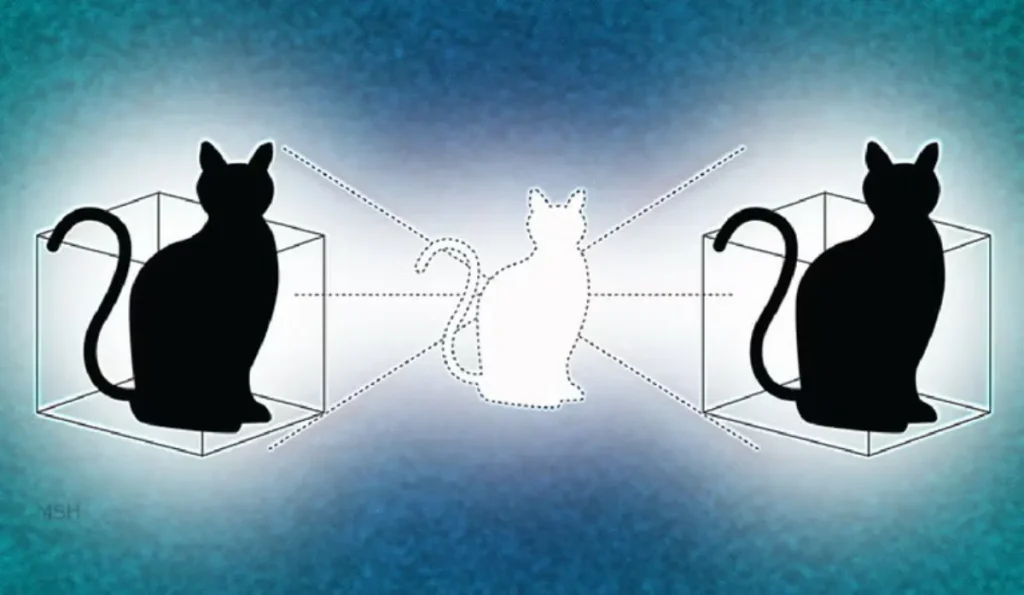
Redefining a Legendary Physics Thought Experiment
The international scientific community is currently buzzing following a monumental publication in the prestigious journal Physical Review X. For decades, the famous thought experiment of Schrödinger’s cat has served as the ultimate illustration of quantum superposition—the bizarre reality where an object exists in multiple opposing states simultaneously. Now, researchers at the University of Oxford have successfully executed an epic quantum leap, completely redefining how these paradoxical states are constructed.
Historically, when physicists attempted to recreate this effect in laboratory settings, they utilized highly predictable, coherent wave packets that closely mimic classical physics. However, the Oxford team, led by Dr. Sebastian Saner, decided to push the boundaries of reality. Instead of using standard wave packets, they engineered superpositions out of deeply exotic, highly nonclassical components, effectively making the legendary cat significantly stranger than ever before.
Trapping a Single Strontium-88 Ion
To successfully achieve this groundbreaking quantum leap, the research team utilized an incredibly sophisticated experimental platform centered around a single trapped strontium-88 ion. By suspending this single atom within a three-dimensional Paul trap, the physicists effectively gained access to two distinct quantum systems simultaneously. The internal electronic state of the ion functioned as a standard qubit, while its physical motion behaved as a complex quantum harmonic oscillator.
By intricately coupling these two independent degrees of freedom, the researchers could use the qubit as a precise control lever to heavily manipulate the ion’s physical motion. Through a mid-circuit quantum measurement, they projected the ion’s motion into a chosen superposition without accidentally destroying the delicate motional state. This unprecedented level of control allowed the Oxford team to sculpt the superposition into virtually any desired geometric shape.
Squeezed, Trisqueezed, and Quadsqueezed States
What truly separates this experiment from previous laboratory achievements is the sheer weirdness of the foundational building blocks utilized. Rather than relying on familiar coherent states, the physicists built their superpositions using “squeezed,” “trisqueezed,” and “quadsqueezed” motional states. Successfully combining these highly nonclassical ingredients represents a massive quantum leap in the field of continuous-variable quantum mechanics.
Because the experimental setup was highly programmable, researchers could actively tune the relative size, phase rotation, and separation of the individual quantum components. They could even combine completely different types of exotic states—like mixing a squeezed state with a trisqueezed state—into one single, cohesive superposition. This extraordinary flexibility provides scientists with a vastly expanded design space for engineering future quantum technologies.
Proving the Impossible via State Tomography
To definitively prove that they had successfully created these bizarre “sibling” cat states, the team utilized a complex reconstruction process known as state tomography. By executing a series of precise measurements, they reconstructed the full mathematical representation of the quantum states in phase space. The results confirmed exactly what the team was hoping for, officially cementing this historic quantum leap.
The reconstructed visual models displayed striking geometric interference patterns and deep regions of Wigner negativity. In the realm of quantum physics, significant Wigner negativity is an absolute, undeniable signature that a state is genuinely quantum and cannot be explained away as an ordinary classical mixture. These uniquely sculpted states possessed a much higher degree of “quantum resourcefulness” than traditional cat states, making them incredibly valuable for future research.
Paving the Way for Resilient Quantum Computing
While the fundamental physics of the experiment are fascinating, the practical applications for the burgeoning tech sector are truly massive. Encoding complex data into these deeply exotic oscillator states offers a highly promising pathway toward building significantly more resilient quantum computers. Because these states distribute quantum uncertainty differently, they are potentially much less susceptible to the catastrophic bit-flip errors that plague traditional binary qubits.
Beyond revolutionizing computational error correction, this quantum leap holds immense potential for advancing ultra-precise quantum sensing and navigation technologies. Furthermore, having programmable control over such extreme superpositions provides physicists with a pristine laboratory environment to study the exact boundary where quantum mechanics transitions into classical reality. The Oxford team believes they are only just scratching the surface of what these strange new states can ultimately achieve.
Conclusion
In conclusion, the University of Oxford’s successful generation of highly exotic Schrödinger’s cat states marks a profound milestone in modern physics. By utilizing a trapped ion to sculpt nonclassical superpositions, researchers have executed an epic quantum leap that will heavily influence future technological developments. As scientists continue to explore these programmable, squeezed states, the boundaries of quantum computing and precision sensing will expand dramatically.
Frequently Asked Questions (FAQ)
Question 1: What major breakthrough did Oxford physicists achieve regarding Schrödinger’s cat?
The researchers successfully created an entirely new family of “cat states” built from highly exotic, nonclassical quantum components rather than standard coherent wave packets.
Question 2: How did the research team create these bizarre new quantum superpositions?
They achieved this quantum leap by manipulating a single trapped strontium-88 ion, using its internal qubit state to sculpt its physical motion into complex geometric shapes.
Question 3: What are “squeezed” and “trisqueezed” quantum states?
These are highly nonclassical, exotic quantum states where quantum uncertainty is distributed unevenly, making them significantly stranger and more complex than ordinary quantum waves.
Question 4: Why is Wigner negativity important in this specific physics experiment?
Regions of Wigner negativity in the mathematical reconstructions serve as absolute proof that the generated states are genuinely quantum and not just standard classical mixtures.
Question 5: How could this quantum leap improve future technology?
Encoding information within these complex, nonclassical superpositions could lead to much more resilient quantum computers that are better protected against data-destroying errors.